Wednesday, May 25, 2016

The Israeli/Arab Conflict - The Peel Commission - 1937


1. Introduction of the Issue


Israel Before The British Mandate 
The question than, is if there has never been a country approximating Israel that was a Muslim/Arab country, and the original usage of the word for a geographical area "Palestine" by the British explicitly provided for a Jewish State, than why are Arabs in Israel now and since the British Mandate referred to as "Palestinians" as if they are the original citizens of a country called "Palestine"? 


The Israeli/Arab Conflict - The McMahon–Hussein Correspondence - 1916
"1. By allying with the British and helping to defeat the Ottomans, the Arabs did earn a national Arab State in the Middle East. 
2. The British promise/agreement to the Arabs for an Arab State preceded any such agreement with the Jews for a Jewish State in Israel.  
3. The British were clear that not all of the Middle East would be an Arab State and never formally communicated to the Arabs that Palestine would be part of an Arab State. 
4. While there never has been an Arab and or Muslim State approximating the area of Israel and under the Ottomans there was no "Palestine" entity or governing area approximating Israel, the British did use the name "Palestine" to refer to the area." 

The Israeli/Arab Conflict - The Balfour Declaration - 1917 
"Violent Arab rejection of The Balfour Declaration of 1917 was the start of the Israeli/Arab conflict which has continued to the present time. We will also see in subsequent posts here that the position of the two sides regarding Jewish and Arab states in Israel has not changed since 1917:

Jewish position - Has always been in favor of and offered Two-State solution.

Arab position - Has always opposed and rejected offer of Two-State solution."


2. Discussion


The Peel Commission - 1937 


"The Peel Commission, formally known as the Palestine Royal Commission, was a British Royal Commission of Inquiry, headed by Lord Peel, appointed in 1936 to investigate the causes of unrest in The League of Nations Mandate for Palestine administered by Britain following the six-month-long Arab general strike in Mandatory Palestine.
On July 7, 1937, the commission published a report that, for the first time, stated that the Mandate had become unworkable and recommended partition.[1] British cabinet endorsed the Partition plan in principle, but requested more information.[2]"

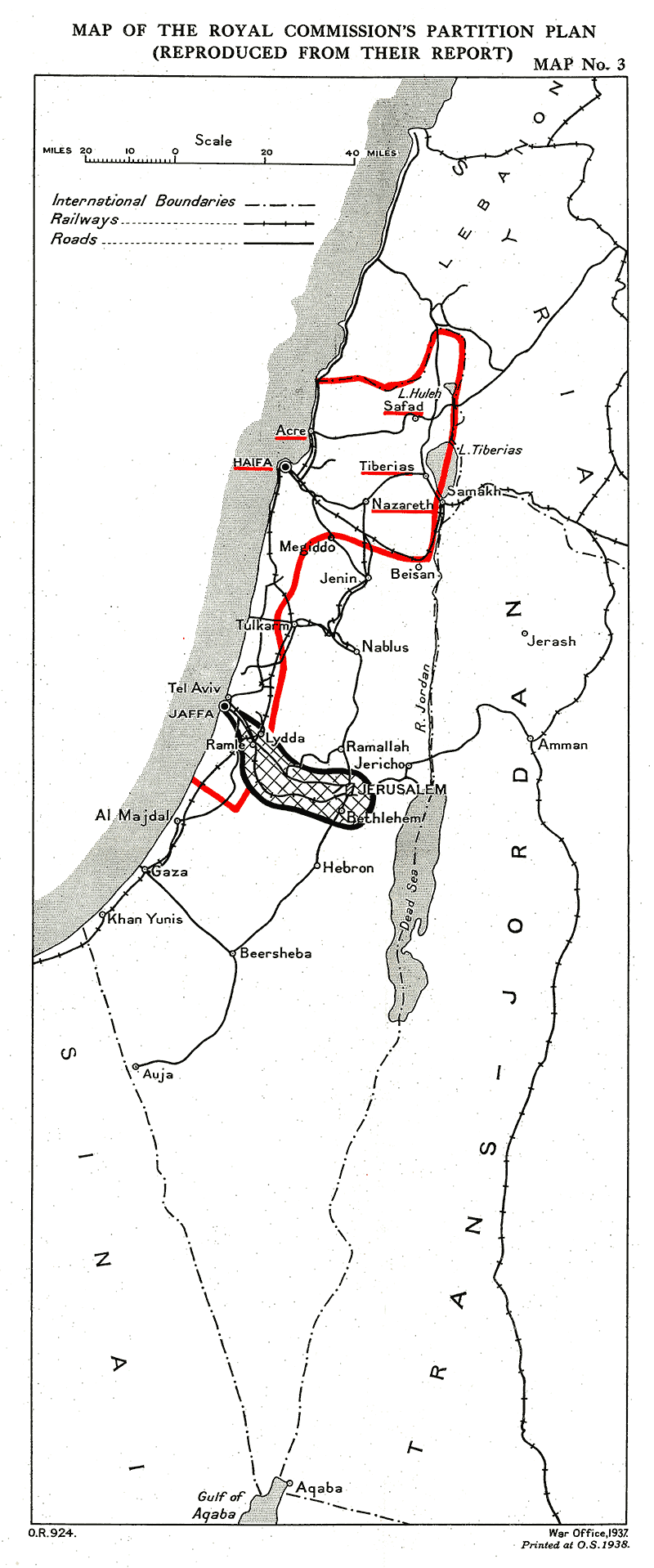
The Partition was per the following map with the Jewish side bordered in red:


"A Treaty system based on the Iraqi-Syrian precedent, proposed: Permanent mandates for the Jerusalem area and "corridor" stretching to the Mediterranean coast at Jaffa—and the land under its authority (and accordingly, the transfer of both Arab and Jewish populations) be apportioned between an Arab and Jewish state. The Jewish side was to receive a territorially smaller portion in the mid-west and north, from Mount Carmel to south of Be'er Tuvia, as well as the Jezreel Valley and the Galilee, while the Arab state linked with Trans-Jordan was to receive territory in the south and mid-east which included Judea, Samaria, and the sizable Negev desert.[18]"

Key related points -

1) Motivation - Britain decided that the current Mandate was not sustainable because Britain could not keep the peace. Primarily because of Arab violence and protest.


2) Expectation - Britain's expectation was unclear because The Peel Commission Plan was a defensive plan with Britain feeling forced to do what it did not want to do and was not ready to do.


3) Limitation - The Arab portion would not be an independent State but would become a part of Jordan. The Jewish State would have to pay a tax to help support the Arab side in order to relieve Britain of the burden. There would be a significant transfer of Arabs to the Arab portion and no specific plan to improve irrigation for the Arab side.


4) Development - The Jewish side was deliberately given a higher ratio of land in recognition that Jews provided more tax revenue per capita which would reduce/eliminate Britain's related financial support obligation. Britain recognized that Jewish immigration had significantly improved living conditions in Israel for everyone.

Jewish reaction -  

To the previous McMahon–Hussein Correspondence of 1916 promising the Arabs that most of Palestine would be an Arab state = None. 

To the Balfour Declaration of 1917 = Acceptance. Hope was turned into possibility and preparations were started for a Jewish State. The emphasis was on the creation of a Jewish State with little thought as to the extent of the Jewish State and whether there would also be a Palestinian state in Israel. 

To The Peel Commission of 1937 = Acceptance of the Plan in general but rejection of the specific borders as too small. Created committee to negotiate specific borders.


Arab reaction -

To the previous McMahon–Hussein Correspondence of 1916 promising the Arabs that most of Palestine would be an Arab state = Acceptance.

To the Balfour Declaration of 1917 = Rejection. The Arabs were clear that not only would they reject the creation of any Jewish state in Israel but they would be violently opposed. 

To The Peel Commission of 1937 = Rejection. The primary specific complaint was that it would give the Jews the best land. The Arabs rejected the granting of any land to the Jews under any form of administration and demanded an end to Jewish immigration. 

3. Conclusion


Even though the Peel Plan was the first specific partition plan it became the basis for all subsequent partition plans. The Plan favored the Jewish side because of British financial reasons and the thinking that the Jewish need for a State was much greater than the Arab need. From an Arab standpoint the Plan was unfavorable because they would receive the less developed land (even though the Jews were responsible for most of the development), they would receive proportionately less land based on relative populations (even though this would benefit both sides from a budget standpoint), most transfers would be of Arabs and they would not have an independent State but become a part of Jordan. 

Violent Arab rejection of The Balfour Declaration of 1917 was the start of the Israeli/Arab conflict which has continued to the present time and was the primary Arab reaction to The Peel Commission. We will also see in subsequent posts here that the position of the two sides regarding Jewish and Arab states in Israel has not changed since 1917:


Jewish position - Has always been in favor of and offered Two-State solution.

Arab position - Has always opposed and rejected offer of Two-State solution.  

In hindsight, the greatest tragedy regarding the failure of a Two-State solution was not that the Arabs still don't have a related State but that 6,000,000 Jews were murdered by a Country with the same main religion as Britain in a Continent with the same religion because there was no Jewish State at the time. 

Critics of Israel will try to demonize Israel by posturing and only looking at The Jews/Zionists/Israel's supposed eternal goal of wanting it all. But we need to distinguish between wanting and accepting. It's normal to want more than you are willing to accept but in negotiations what is most important is what you are willing to accept. And that is the difference between Israel and the Arabs and has always been the difference. Regardless of what both sides supposedly want, Israel has always been willing to accept a two-State solution and the Arabs have not.


 

Saturday, May 21, 2016

The Strange Chapter Of Dr. Jewkyll And Mr. Hymn


My name is Dr. Henry Jewkyll. I’m a tenured professor of psychiatry at a University. “Tenured” means that basically I’m retired except that I still receive a monthly paycheck. I’ve always been fascinated by the effect that ancient religious writings have on the behavior of many people. There seems to be an intrinsic human desire to believe that the older a writing is the more credibility it has. I can easily understand how a person could come to believe that an ancient religious writing is the absolute truth if they have been raised in a culture which has always taught them to believe that. But what if a person is exposed to an ancient religious writing which is different than the culture they were brought up in? Which is stronger? The religion of one’s upbringing or later, exclusive exposure to a different religion’s ancient writings?

I’ve decided to conduct an experiment to determine which is stronger and because I’ve had a lot of free time since I became tenured I will be the subject of the experiment. My own upbringing is Reform Judaism where the Bible is seen as mainly figurative and designed to teach moral and ethical lessons. I will be gradually exposing myself to ancient Christian religious writings. Every morning I will select a specific Christian writing to read later. I will then temporarily self-hypnotize myself into believing that I had no religious upbringing and currently have no religious views of any kind. After hypnosis I will read the selected Christian writing and at the end of the day I will note in a diary any changes in my behavior.

The Christians claim that Isaiah Chapter 53 is the best evidence of the truth of Christianity so that will be the first writing I select for reading.

Thursday, May 19, 2016

The Israeli/Arab Conflict - The Balfour Declaration - 1917


1. Introduction of the Issue


Israel Before The British Mandate 
The question than, is if there has never been a country approximating Israel that was a Muslim/Arab country, and the original usage of the word for a geographical area "Palestine" by the British explicitly provided for a Jewish State, than why are Arabs in Israel now and since the British Mandate referred to as "Palestinians" as if they are the original citizens of a country called "Palestine"? 


The Israeli/Arab Conflict - The McMahon–Hussein Correspondence - 1916
"1. By allying with the British and helping to defeat the Ottomans, the Arabs did earn a national Arab State in the Middle East. 
2. The British promise/agreement to the Arabs for an Arab State preceded any such agreement with the Jews for a Jewish State in Israel.  
3. The British were clear that not all of the Middle East would be an Arab State and never formally communicated to the Arabs that Palestine would be part of an Arab State. 
4. While there never has been an Arab and or Muslim State approximating the area of Israel and under the Ottomans there was no "Palestine" entity or governing area approximating Israel, the British did use the name "Palestine" to refer to the area." 


2. Discussion


The Balfour Declaration of 1917:

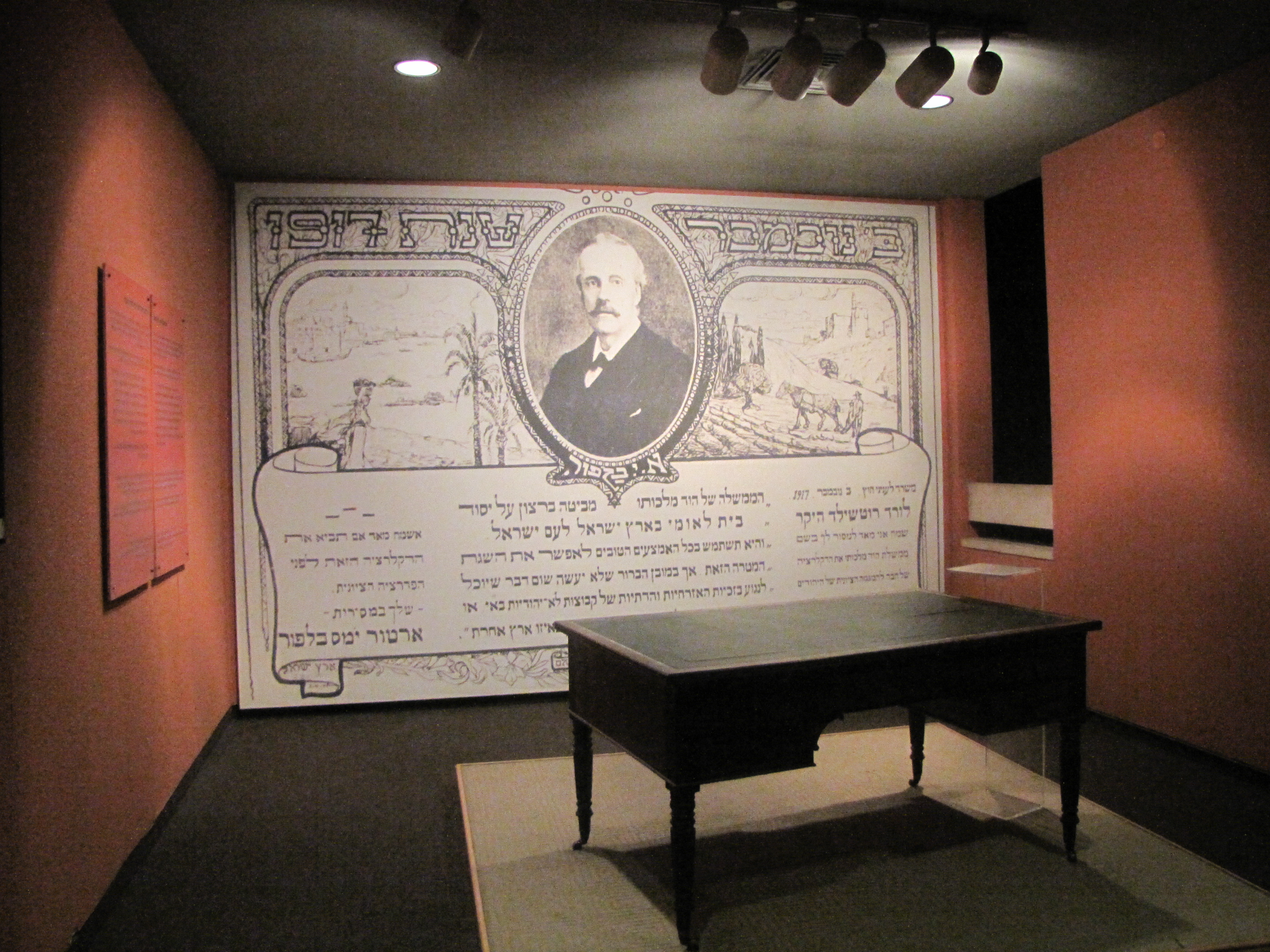
"The Balfour Declaration was a letter dated 2 November 1917 from the United Kingdom's Foreign Secretary Arthur James Balfour to Walter Rothschild, 2nd Baron Rothschild, a leader of the British Jewish community, for transmission to the Zionist Federation of Great Britain and Ireland. It read:
His Majesty's government view with favour the establishment in Palestine of a national home for the Jewish people, and will use their best endeavours to facilitate the achievement of this object, it being clearly understood that nothing shall be done which may prejudice the civil and religious rights of existing non-Jewish communities in Palestine, or the rights and political status enjoyed by Jews in any other country.[1][2]"
Key related points -

1) Motivation - Britain hoped that Jews in the United States and Russia would help move their governments towards support of Britain's Middle East objectives. Also, Jews were well represented in the British government at the time.

2) Expectation - Britain's expectation was that the creation of a Jewish homeland would cause mass Jewish immigration to Israel. 

3) Limitation - Britain deliberately used wording of "in Palestine" instead of "of Palestine" in order to make clear that the Jewish homeland would only be located within Palestine and not consist of all of Palestine. 

4) Development - Jewish interest in Israel created significant investment from European Jews which greatly increased the agricultural output of Israel benefiting all inhabitants and reducing the investment required by Britain in Israel.  

Jewish reaction -  

To the previous McMahon–Hussein Correspondence of 1916 promising the Arabs that most of Palestine would be an Arab state = None. 

To the Balfour Declaration of 1917 = Acceptance. Hope was turned into possibility and preparations were started for a Jewish State. The emphasis was on the creation of a Jewish State with little thought as to the extent of the Jewish State and whether there would also be a Palestinian state in Israel. 

Arab reaction -

To the previous McMahon–Hussein Correspondence of 1916 promising the Arabs that most of Palestine would be an Arab state = Acceptance.

To the Balfour Declaration of 1917 = Rejection. The Arabs were clear that not only would they reject the creation of any Jewish state in Israel but they would be violently opposed. 

3. Conclusion


Violent Arab rejection of The Balfour Declaration of 1917 was the start of the Israeli/Arab conflict which has continued to the present time. We will also see in subsequent posts here that the position of the two sides regarding Jewish and Arab states in Israel has not changed since 1917:

Jewish position - Has always been in favor of and offered Two-State solution.

Arab position - Has always opposed and rejected offer of Two-State solution.  


Wednesday, May 18, 2016

The Case Of The Unidentified Servant - Part 3


From The Memoirs Of Sherlock Holmes


Holmes: Now, here's where our first hand knowledge of Hebrew will
come in handy Watson. 53:5, the Christian translation says "He
was wounded for our sins." But the original Hebrew word
translated as wounded is "lamoh" which is the PLURAL form of
wounded, i.e. THEY were wounded. Also the word the Christians
translated as "for" should be "from". The proper translation is
"they were wounded BECAUSE of our sins". And the last
sentence of 53:5 is translated by the Christians as "And by his
bruises we ARE healed." But the original Hebrew is written in the
past tense, "And by his bruises we WERE healed". Finally, 53:9
"And his grave". The word for grave in the original Hebrew is
written in the plural, "And THEIR graves." Looking at
the Chapters after 53 virtually every bad thing that happens to the
suffering servant of Chapter 53 is explicitly stated as happening
to Israel and similarly every good thing that happens to the
servant is explicitly stated as happening to Israel.


So, in summary Watson, Israel is explicitly identified as G-d's
servant, fourteen times. Isaiah explains that once Israel repents
from its sins it will become a righteous example for the Nations
which are still sinful and mistreating Israel. There are words used
in Chapter 53 indicating that a plurality of people are being
referred to. And, virtually every thing that is described as
happening to the suffering servant in Chapter 53 is explicitly
stated as happening to Israel elsewhere in the writings of Isaiah.
Now, based on these facts, who do you suppose the suffering
servant of Isaiah, Chapter 53 is Watson?

Watson: Uhm, Israel?

Holmes: Precisely!

Watson: Good show Holmes you've' solved the case. Should I inform Lord
Disraeli?

Holmes: I think not Watson, he died six years ago. Call Rabbi
Signorenson instead. Here's his number.

Watson: What the deuce for Holmes? (dials number).

Holmes: Why, so we can convert to Judaism of course. Now that we know
who the suffering servant really is we don't have much choice, do
we? Besides, your chess game could use the improvement that
will surely come from being part of the chosen people.

Watson: Holmes, Rabbi Signorenson says that before we can convert we
have to be circumcised. He says that he can make an
appointment for us tonight at the hospital.

Holmes: Make it for tomorrow night Watson. Right now I feel as though
something nutritious at Simpsons would be appropriate. Say a
jumbo shrimp appetizer and then the house specialty, a whole
roasted pig basted all day in Miller High Lite beer. Washed down
by an extremely tall glass of milk. If we're going to have to start
keeping kosher I want to go out on a real bender.

Watson: My memory escapes me Holmes. How exactly do we get to
Simpsons from here?

Holmes: By carriage Watson, by carriage.


Saturday, May 14, 2016

The Case Of The Unidentified Servant - Part 2


From The Memoirs Of Sherlock Holmes


6:8 "Then I heard the voice of my Lord saying, "Whom shall I send? Who
will go for us?" And I said, "HERE AM I: SEND ME." And He said,
"Go, say to that people:"

 
Holmes: So Isaiah has been selected to give a message to Israel, Watson.


6:13 "But while a tenth part yet remains in it, IT SHALL REPENT. It
shall be ravaged like the terebinth and the oak, of which STUMPS
are left even when they are felled: ITS STUMP SHALL BE A
HOLY SEED."


Holmes: So Israel will be decimated but a few will survive
and repent and serve some holy purpose.

20:3 "…Just as My servant Isaiah"

Holmes: Looks like you were right about Isaiah, Watson.

41:8 "But you, Israel, My servant,"

Holmes: Okay, that's one Watson. Let's keep track of how many times Israel is called "servant".

41:9 "…To whom I said: You are My servant;

Holmes: Two.

42:1 "This is My servant, whom I uphold,
My chosen one, in whom I delight.
I have put My spirit upon him,
He shall teach the true way to the nations.
He shall not cry out or shout aloud,"


Holmes: Three

42:6 "I the LORD, in My grace have summoned you,
And I have grasped you by the hand.
I created you, and appointed you
A COVENANT PEOPLE, A LIGHT OF NATIONS-
Opening eyes deprived of light,
"

Holmes: It's clear that the servant described in 42:1 is Israel.

42:19 "Who is so blind as My servant, So deaf as the messenger I send?
Who is so blind as the chosen one, So blind as the servant of the LORD"


Holmes: Four and five.

42:21 "The LORD desires His (servant's) vindication,
That he may magnify and glorify (His) Teaching."


Holmes: This Isaiah chap seems to be saying Watson that a FORMERLY
sinful Israel will BECOME righteous and serve as a good example
for the nations.

43:10 "…My servant, whom I have chosen."

Holmes: Six

44:1 "But hear, now, O Jacob My servant,
Israel whom I have chosen!"


Holmes: Seven

44:2 "…Fear not, My servant Jacob,
Jeshurun whom I have chosen,
"

Holmes: Eight

44:21 "Remember these things, O Jacob
For you, O Israel, are My servant:
"

Holmes: Nine

44:21 "…I fashioned you, you are My servant-
O Israel, never forget Me.
"

Holmes: Ten

44:26 "But confirm the word of My servant
And fulfill the prediction of My messengers."


Holmes: Eleven

45:4 "For the sake of My servant Jacob,
Israel My chosen one,
"

Holmes: Twelve

48:16 "…And now the Lord God has sent me, endowed with His spirit"

Holmes: It would seem Watson that Isaiah is the messenger or servant to
Israel.

48:21 "Say: "The LORD has redeemed His servant Jacob!"

Holmes: Thirteen.

49: …The LORD appointed me before I was born,
… And He said to me, "You are My servant, Israel in whom I glory"
… AND NOW THE LORD HAS RESOLVED-
HE WHO FORMED ME IN THE WOMB TO BE HIS
SERVANT-
TO BRING BACK JACOB TO HIMSELF,
THAT ISRAEL MAY BE RESTORED TO HIM.
AND I HAVE BEEN HONORED IN THE SIGHT OF THE
LORD,
MY GOD HAS BEEN MY STRENGTH.
FOR HE HAS SAID:
"IT IS TOO LITTLE THAT YOU SHOULD BE MY SERVANT
IN THAT I RAISE UP THE TRIBES OF JACOB
AND RESTORE THE SURVIVORS OF ISRAEL:
I WILL ALSO MAKE YOU A LIGHT OF NATIONS,
THAT MY SALVATION MAY REACH THE ENDS OF THE
EARTH."


Holmes: Ahaah. So Isaiah is the servant to Israel and Israel is the servant to
the nations.

50:4 "The Lord GOD gave me a skilled tongue,
To know how to speak timely words to the weary."


Holmes: Isaiah

50:10 "Who among you reveres the LORD
And heeds the voice of His servant?


Holmes: Isaiah

52:13 "Indeed, My servant shall prosper,"

Holmes: Fourteen


Sunday, May 8, 2016

The Case Of The Unidentified Servant - Part 1


From The Memoirs Of Sherlock Holmes


Ah, I remember it well, my most difficult case. It was three o-clock in the
morning and Mrs. Hudson was still puttering about in the kitchen while I,
was busy playing Mumbleepeg, with the cat. Pfft-tingg, MEOW!!! Oops,
sorry cat. Two out of three? When the phone rang.

Holmes: Hello…yes I am…I see.

My laundry was ready.

Later that morning I received an urgent message from Scotland Yard as
follows:

"My dear Mr. Sherlock Holmes, Her Majesty wishes to know as soon as
possible who exactly is the "suffering servant" described by the Hebrew
prophet, Isaiah, in Chapter 53 of the writings bearing the same name. The
Bishop of Bristles tells her it's Jesus, the Cantor of Canterbury tells her it's
the Jews and her personal servant tells her it's him. She still remembers the
fine job you did for her during "The Affair Of The Missing Watch" when
you deduced that if you keep looking and looking for something and you
just can't seem to find it anywhere, it probably means that it's lost.
Anyway, she insisted that you be given this assignment. God/Jews/Personal
Servant? Save The Queen!


Sincerely, Lord Benjamin Disraeli, Her Majesty's Minister of Religion (Mrs.)"


I immediately called up my associate and trusted friend, Dr. Watson.

Holmes: Come here immediately Watson, the game is afoot.

Watson: Should I bring my revolver?

Holmes: I think not Watson. This case involves Jews. Leave your revolver at home. Bring bagels.

Watson arrives toting a large bag with an assortment of bagels. As they
start to munch on their bagels Holmes fills in Watson on the case.

Holmes: In order to properly understand what the Hebrew prophet Isaiah
was saying, we must first learn to understand the language that
he wrote in, Hebrew. That is the key to this case. I have made
arrangements with my good friend, Dr. Sigmund Freud, of
Vienna, to not only teach us Hebrew through correspondence but
also, through Freud's psychological training, to help us to
understand the meaning of what Isaiah wrote within the context
of the other sixty-six chapters. We should be receiving our first
correspondence lesson from Dr. Freud by the end of the week.

Watson: Brilliant Holmes. Do you foresee any problems?

Holmes: Just one Watson. Your breath, it's ghastly! Didn't anyone ever
tell you that garlic bagels were only meant to be eaten when
dining alone?

Watson: Sorry Holmes.

Holmes: (Grabs bag of bagels from Watson) Perhaps I can find a more
suitable choice. (Digs through bag and finds onion bagel) No
(tosses bagel across the room. Continues search and finds
jalapeno bagel) Egads! (Jalapeno bagel meets same fate as
onion bagel. Gets to bottom of bag and sees poppyseed bagel)
Hullo. (takes out bagel and stuffs it into Watson's mouth).

Watson: (muffled) thpfnkyfu.

Holmes: You're welcome.

Later that week they receive their first correspondence lesson from Freud:

"My dear Sherlock Holmes. Greetings. Our lesson for today is the Hebrew
word "Shalom" which means "hello". Repeat after me, "Shalom".


Sincerely, Dr. Sigmund Freud"


Holmes: Hmm. This may take a bit longer than I had originally anticipated
Watson. (They stare at each other for a few seconds, then at the
letter, then at each other and say simultaneously, "Shalom".

(Seven years later.)

Holmes: Alright Watson, I believe that we are now sufficiently proficient
In Hebrew so as to begin our analysis of the text. I have made
arrangements to borrow this ancient manuscript of Isaiah from
The British National Museum which is written in the original
Hebrew. That way we won't have to worry about any biases that
an interpreter may have had. Now, Watson, where should we
start?

Watson: At the beginning?

Holmes: Exactly. And what is the first Chapter?

Watson: Chapter one?

Holmes: Precisely! (Holmes takes a magnifying glass to the beginning of
"Isaiah").

Watson: Holmes, I have an idea.

Holmes: What is it Watson?

Watson: Well, seeing as we are looking for the identity of the servant in
Chapter 53 and the name of the writing is "Isaiah". Could the name
"Isaiah" possibly be a clue in some way as to the identity of the
servant?

Holmes: Could be Watson. Could be. Hypothesis number 1, Isaiah is in
some capacity the servant described in Chapter 53. Good work
Watson.

Watson: (blushing) Thanks Holmes.

Holmes: Now, let us proceed with our search of the actual text.

Wednesday, February 3, 2016

European Sympathy for Palestinians and Criticism for Israel - Motivated by Morals or Self-Interests?

1. Introduction of the Issue


   The three largest economies of Europe are Germany, France and Great Britain. What are the general positions of each regarding the current Israeli/Palestinian conflict?:


   GermanyThe German Federal Foreign Office Website:


   "The unresolved conflict between Israelis and Palestinians is at the centre of the many different conflict areas in the Middle East."


 The Israeli/Palestinian conflict is at the center of all Middle Eastern conflicts? This is a common propaganda statement by Palestinians, Arabs, Muslims and anti-semites that Israel is in some/a large way responsible for other/all problems in the Middle East/World. What does Israel have to do with ISIL, Egyptian dictatorship, Turkish discrimination against Kurds, Lebanese discrimination against Christians, Al-Qaeda, Iraqi civil War, Syrian civil War, the Saudi Iranian feud, Yemen civil war and Sunni/Shiite competition?


   "The final status issues: the border, the status of Jerusalem, the future of the Israeli settlements in the occupied territories, the Palestinian claim to a right of return for refugees and the distribution of scarce water resources remain unresolved."


   Note that all of these are Palestinian issues. No mention of the most important issue for Israel which is security. In the entire referenced page above there is no mention of Palestinian Terrorism even though Germany considers Hamas a terrorist organization and as this Blog has shown: The Palestinian Authority is currently a Terrorist Organization Under International Law

  Germany than, seems to favor the Palestinian/Arab point of view over the Israeli point of view. Germany of course would claim that their position on the issue is based primarily on morals and ethics. But could there be another reason, less important or even more important? We will see that of the three largest European economies that the German position is the least critical of Israel.


   FranceIsrael/Palestine: 10 keys to understand France’s position:


   "2. France condemns without reservation terrorist acts aiming to sabotage hopes for peace.


   It is fully committed to the security of Israel; this is a key principle of its policy in the region. 
  That is why it calls on Hamas, which is on the European list of terrorist organisations, to adhere to the conditions set by the Quartet: the renunciation of violence, the recognition of the right of Israel to exist and the recognition of the agreements signed between Israel and the PLO.
   France has also called on Israel to comply fully with international humanitarian law and to exercise a “proportionate use of force”, particularly in the Gaza conflict in the summer of 2014, causing more than 2,100 victims."


  Regarding condemnation of terrorist acts France only condemns Hamas but not the Palestinian Authority even though the Palestinian Authority has a long history of its own terrorist acts and is currently a terrorist organization under International Law. France does include Israel though under its condemnation of terrorist acts even though Israel was acting in accordance with International Law while defending itself against Gazan terrorist attacks and quasi-war. 


   "7. France provides its support to the Palestinian Authority and Mahmoud Abbas, who is on the side of peace. 


   France actively contributes to institution building for the future Palestinian State. It allocated nearly €400 million over the period 2008-2014 to help Palestine, with nearly one third benefiting Gaza. Palestine remains the main beneficiary of French budgetary aid."

  As documented by Palestinian Media Watch starting on Rosh Hashanah of last year, the most important Jewish religious day of the year, the Palestinian Authority led by Abbas, started a terrorist campaign against Israel (including numerous casualties of Palestinian teenagers killed/injured while trying to murder Jewish children/grandmothers) which continues to this day.  

  Also documented by Palestinian Media Watch is that the Palestinian Authority spends a relatively high percent of their budget financially rewarding terrorists and Hamas likewise spends a relatively high percent of their budget building/trying to build terror tunnels. So France is helping to fund Palestinian terrorism. Congratulations. 

   "10. France will recognise the Palestinian State


   France has long called for the creation of a Palestinian State at the end of negotiations. A State for Palestinians is a right, repeatedly reaffirmed, and acknowledged in the partition plan of the mandated Palestine (1947). However, recognition of the State of Palestine must serve peace. That is why France defends the idea that this should happen within the framework of a comprehensive and definitive solution to the conflict, negotiated by the two parties. If negotiation is impossible, or if there are no conclusions, France will shoulder its responsibilities by recognising without delay the State of Palestine."

  France's official position is that if there is no agreement between Israel and the Palestinians, than France will soon unilaterally recognize a Palestinian State. So despite France's points above that there should be an agreement providing security for the parties in theory and practice, this is not the most important point for France or even a required condition for recognition of a Palestinian State.

  Great Britain2010 to 2015 government policy: peace and stability in the Middle East and North Africa:

  "The search for Middle East Peace continues to be an urgent priority in 2014. This conflict matters to British national security, and to the security of the entire region, and we will take every opportunity to help promote a peaceful two-state solution." 

   The same policy statement as Germany, that a two-State solution is somehow important to the entire Middle East. 

  "Settlements
We are concerned by developments that threaten the viability of the two-state solution. Changing circumstances, in particular the construction of settlements on occupied land in the West Bank and East Jerusalem, mean that the two-state solution is slipping away.
Our position on Israeli settlements in the Occupied Palestinian Territories is clear: they are illegal under international law, an obstacle to peace and make a two-state solution harder to achieve. We consistently urge the Israeli authorities, including at the highest levels, to cease all settlement building, revoke previous announcements and to remove illegal outposts, as required under international law."

  "International law obligations
We believe that Israel has legal obligations as an occupying power with respect to the Occupied Palestinian Territories under applicable international law and international humanitarian law, including the Fourth Geneva Convention.
We have a regular dialogue with the Government of Israel about the implementation of those obligations and raise our serious concerns regarding such issues as treatment of Palestinian prisoners, including children, demolitions of Palestinian property, restrictions on movement and access. More details can be found in the FCO’s annual human rights and democracy report."

  Great Britain has unilateral support for the major complaints of the Palestinians, Settlement expansion, and supposed mistreatment of Palestinians and their property (and also financially supports Palestinian economic development). No mention of any complaint of Israel so no mention that Hamas has long been a Terrorist organization and the Palestinian Authority is currently one. 

  In summary we see that the three largest economic powers in Europe generally support all major Palestinian demands but support the main Israeli demand of an end to terrorism to a lesser degree. While Israel insists that a condition of negotiations is a stopping of terror, none of the Europeans here require that as a condition and either do not even mention Palestinian terrorism in their official policy statements or speak of terrorism here as a general issue for both sides. Especially noticeable is that none even mention the current campaign of Palestinian terrorism promoted by the Palestinian Authority. 

  As evidenced above the Europeans favor the Palestinian side of the conflict. The question than is why? Is it simply because of European morals (ironic, since it is all because of a lack of European morals that Israel was needed in the first place) or could there be another reason?

2. Discussion


 The Switzerland model -

As  reported by the BBC: Switzerland 'made secret deal with PLO' after bomb attacks

The source is "Now, in a book by Swiss journalist Marcel Gyr, information has emerged indicating that, in the stressful days and nights while Switzerland tried to get its hostages released, Swiss Foreign Minister Pierre Graber secretly contacted the PLO" 

And the circumstantial evidence:

Cause:

"It followed a series of attacks in 1969 and 1970 by Palestinian groups that caused huge concern in Switzerland.
  • In February 1969 gunmen opened fire at Zurich airport on an El Al plane, whose pilot died in the attack. The Swiss arrested the attackers
  • In 1970, a bomb on board a Swissair flight to Tel Aviv brought the plane down just outside Zurich, killing all 47 passengers and crew
  • In September 1970, a Swissair flight on its way to New York was hijacked. Two other airliners, one British, one American, were hijacked at the same time. All three ended up at Dawson's Field airstrip in Jordan, where more than 300 passengers were held hostage"

  Effect:


"Using a member of the Swiss parliament as an intermediary, but without informing his fellow government ministers, Mr Graber, the new revelations suggest, came to an agreement under which those charged for the attack on the El Al plane would be released in return for freeing the hostages. 


In addition the investigation into the bombing of the Swissair flight would be quietly shelved, and Switzerland would use its diplomatic offices to push for international recognition of the PLO.

After 1970, while there were further Palestinian attacks in other European countries, there were none in Switzerland." 

And When In Rome -


As  reported by Arutz Sheva: Fmr. Italian Pres.: We Signed Pact With Terrorists

The source is: "
In a letter appearing in the weekend edition of the respected Italian newspaper Corriere della Sera, former Italian President Francesco Cossiga revealed that the government of Italy agreed to allow Arab terrorist groups freedom of movement in the country in exchange for immunity from attacks in Italy."

And the circumstantial evidence:

Cause:

"In a letter appearing in the weekend edition of the respected Italian newspaper Corriere della Sera, former Italian President Francesco Cossiga revealed that the government of Italy agreed to allow Arab terrorist groups freedom of movement in the country in exchange for immunity from attacks in Italy."

Effect:


 "While there were several terrorist attacks on targets in Italy in the years following the alleged "protection" deal, most of them could be traced to Abu Nidal's terrorist organization. Abu Nidal rejected the authority of the PLO leadership and many of his attacks, including those in Rome, were assassinations of PLO figures and other Arab diplomats."

Note that Cossiga has also claimed that the US and Israel were behind 911 but it is more likely that Cossiga is credible here as he was/is in position to know Italy's secrets and Arab sources have confirmed the existence of the agreement. 
 
The PLO itself was even kind enough lately to confirm that an objective of its past terrorism was to get European attention and that this campaign was successful:

WATCH: Former Fatah Official, 'Do We Need to Hijack Your Planes to Make You Care?  

“I always say to these people, after I tell them about Syria and IS: ‘Do we have to hijack your planes and destroy your airports again to make you care about our cause? Are you waiting for us to cut off your oil supply? You always wait for things to reach boiling point and explode, causing you harm, before you intervene to end the crimes and violations.'”

Vicha La France -

As  reported by La Parisien Newspaper: Attack on the rue des Rosiers: the secret pact with the terrorists

"37 years after the bombing of the Rue des Rosiers in Paris, the former head of the French intelligence has admitted before a judge to have negotiated an agreement with the group responsible for the killing."

And the circumstantial evidence:

Cause:

"The group Abu Nidal is at the time an armed Palestinian movement, dissident Fatah Yasser Arafat, who commits massacres in France and abroad. 37 years ago, on August 9, 1982, it was 1:15 pm when at least three terrorists armed with machine guns sow death in the restaurant Jo Goldenberg, a figure of the Jewish quarter of Paris. Three minutes later, after throwing a grenade and firing, they fled. Six dead and 22 wounded lie on the ground. Very early in the investigation, the responsibility of the group Abu Nidal is evoked. The bullets found on site are from Maszynowy wz models. 63, a signature of the extremist organization."


Effect:


"The pact is sealed: members of Abou Nidal refugees abroad are allowed to "come to France, without risk" to be prosecuted; in return, they undertake "not to engage in any violent action". The DST even allowed two of the organization's terrorists to visit, in prison, in France, the two perpetrators of the murder of a representative of the Palestine Liberation Organization in Paris.
"And it worked, there was no more attacks from late 83, 84 and until the end of 1985," is satisfied Yves Bonnet audition, which refutes the term "collaboration" and prefers the one of "non-aggression". "After committing attacks in Italy, for example, it did not concern me as long as there was nothing on French soil. ""


3. Conclusion

 
We have the following reasons than to think that European support for the Palestinians is based on their own self-interests rather than European morals and ethics:

1) We've seen above that specific European countries had agreements with the PLO to end PLO terrorist attacks against their countries (or at least against their non-Jews) in exchange for their support of the PLO.

2) Everyone would agree that European countries in general are exponentially more afraid of attacks by Palestinians against them than by Israelis, giving Europeans motivation to support Palestinians.

3) European countries have exponentially larger Arab populations than Jewish populations and their Arab populations pressure them to support the Palestinians.

4) European economic trade with Arabs is exponentially larger than its economic trade with Israel again giving Europe motivation to support the Palestinians.

Thus Europe certainly has the motivation to prefer the Palestinians over Israel based on their own self-interests. One could try to argue though that Europe's preference regarding Israel/Palestinians is primarily based on Europe's observation of Israeli/Palestinian interaction. Except...Europe's own direct experience with the two shows a long (and current) history of itself being a victim of Palestinian terrorism and never being a victim of Israeli terrorism. Combine this with the observation that Europe has traditionally/currently been more likely to label Israel terrorist than the Palestinians. 

This supports the conclusion that Europe's support of the Palestinians is based on its lack of morals and ethics rather than their existence. 

Postscript = As reported by The Times of Israel the current UNESCO resolution Item 19 OCCUPIED PALESTINE uses wording to the effect that all of the Holy Sites of and by The Temple Mount, including The Western Wall, are solely Muslim religious sites. It's generally accepted that the Western Wall and entire Temple Mount area were originally solely Jewish religious sites. The United States, Germany and Great Britain all voted against the resolution. France (where the vote was held) voted for. France, apparently lying for the Palestinians/Muslims here, suggests a current at a minimum implicit agreement with the Palestinians/Muslims to unreasonably support/lie for them similar to the documented agreements above between the Palestinians and Switzerland and Italy.


Postscript = As reported by The Times of Israel:

"Belgium lawmakers from across the political spectrum nominated jailed Fatah leader Marwan Barghouti for the Nobel Peace Prize, Palestinian media reported on Wednesday. Barghouti is currently serving five life sentences in an Israeli jail for his role in murderous terror attacks during the Second Intifada in the early 2000s."  

Having Belgium nominate a Palestinian convicted terrorist that everyone agrees is guilty of multiple murders of innocent women and children for the Nobel Peace Prize soon after Belgium suffered its own terrorist attack by Arabs suggests/proves that Belgium has done so in order to try and protect itself against future Arab terrorist attacks at the expense of encouraging continuing terrorist attacks against Israel. If the Barghouti nomination is unsuccessful, perhaps Mohamed Abrini should be their backup nominee.