Wednesday, June 22, 2016

Star Of David Trek

It’s the year 2,025. Israel has recently achieved final peace with all of its Arab neighbors culminating in the opening of the Benjamin Netanyahu Academy of Acting in Cairo and the Yassir Arafat Institute For Reformed Terrorists in Tel Aviv. Thanks to the new peace Israel has replaced its policy of mandatory military service with mandatory graduation from medical school. Also, because of key military  secrets given to Israel by super spy Jonathan Pollard, Israel has become the world leader in science and technology.

Through the conversion of its resources from military applications  to scientific applications Israel has become the first country to develop a ship, the “USS Enteraplea Pollard,” which is capable of going back in time. The “USS Enteraplea Pollard” has been sent on a secret mission to go back in time and remove Chapter 53 from the writings of Isaiah.

To Be Continued :

Saturday, June 18, 2016

The Israeli/Arab Conflict - The London Conference - 1939

An official picture from The London Conference - 1939. The astute blog reader will notice the Aranomily of the absence of any Jews in the picture.

1. Introduction of the Issue


Israel Before The British Mandate 
The question than, is if there has never been a country approximating Israel that was a Muslim/Arab country, and the original usage of the word for a geographical area "Palestine" by the British explicitly provided for a Jewish State, than why are Arabs in Israel now and since the British Mandate referred to as "Palestinians" as if they are the original citizens of a country called "Palestine"? 


The Israeli/Arab Conflict - The McMahon–Hussein Correspondence - 1916
"1. By allying with the British and helping to defeat the Ottomans, the Arabs did earn a national Arab State in the Middle East. 
2. The British promise/agreement to the Arabs for an Arab State preceded any such agreement with the Jews for a Jewish State in Israel.  
3. The British were clear that not all of the Middle East would be an Arab State and never formally communicated to the Arabs that Palestine would be part of an Arab State. 
4. While there never has been an Arab and or Muslim State approximating the area of Israel and under the Ottomans there was no "Palestine" entity or governing area approximating Israel, the British did use the name "Palestine" to refer to the area." 

The Israeli/Arab Conflict - The Balfour Declaration - 1917 
"Violent Arab rejection of The Balfour Declaration of 1917 was the start of the Israeli/Arab conflict which has continued to the present time. We will also see in subsequent posts here that the position of the two sides regarding Jewish and Arab states in Israel has not changed since 1917:

Jewish position - Has always been in favor of and offered Two-State solution.

Arab position - Has always opposed and rejected offer of Two-State solution."


The Israeli/Arab Conflict - The Peel Commission - 1937 
Even though the Peel Plan was the first specific partition plan it became the basis for all subsequent partition plans. The Plan favored the Jewish side because of British financial reasons and the thinking that the Jewish need for a State was much greater than the Arab need. From an Arab standpoint the Plan was unfavorable because they would receive the less developed land (even though the Jews were responsible for most of the development), they would receive proportionately less land based on relative populations (even though this would benefit both sides from a budget standpoint), most transfers would be of Arabs and they would not have an independent State but become a part of Jordan. 
 

The Israeli/Arab Conflict - The Woodhead Commission - 1938
Because the predecessor Plan, The Peel Commission, was accepted in principle by the Jews but not only rejected by the Arabs but created an Arab position of refusing to accept the creation of any Jewish state, Britain tried to create a new Partition Plan which would be much more favorable to the Arabs. The Woodhead Commission Plan was much more favorable to the Arabs as they would have an independent Palestinian state for Arabs, Jews would be required to contribute substantially to this Arab state and the Jewish state would be one fifth the size of the Palestinian state. As a result though, the Arab position did not change. They would not accept and would violently oppose the creation of any Jewish state.

Violent Arab rejection of The Balfour Declaration of 1917 was the start of the Israeli/Arab conflict which has continued to the present time and was the primary Arab reaction to The Woodhead Commission.

2. Discussion


 The London Conference - 1939


"The London Conference (1939), or St James Palace Conference, was called by the British Government to plan the future governance of Palestine and an end of the Mandate. It opened on 7 February 1939 in St James's Palace after which the Colonial Secretary, Malcolm MacDonald held a series of separate meetings with an Arab and a Jewish delegation, because the Arab delegation refused to sit in the same room as the Jewish delegation. When Maconald first announced the proposed conference he made clear that if no agreement was reached the government would impose a solution. The process came to an end after five and a half weeks with the British announcing proposals which were later published as the 1939 White Paper

Britain's proposals were:

"A limit to Jewish immigration over the following five years after which numbers would be set by agreement with the Palestinian Arabs; restrictions on what parts of the country Jews could buy land.

Gradual introduction of Palestinians, Jews and Arabs, into senior administrative posts.

After a period of ten years the British would transfer all powers to a representative Government."

Key related points -

1) Motivation - Britain's motivation here was to favor the Arab side. The biggest current problem was violent Arab rejection of any Jewish state. Also, World War II was looming and all existing Middle Eastern countries were Arab. 

2) Expectation - Britain's proposal did look like a stalling for time, at least until the War was over. There was a ten year transitional plan before Britain gave up any control and was conditional on an end to the violence. 

3) Limitation - Britain's plan had no specifics.

4) Development - Disproportionate current and future development of Israel by Jews, which benefited/would benefit all inhabitants, was no longer any kind of consideration.

Jewish reaction -  

To the McMahon–Hussein Correspondence of 1916 promising the Arabs that most of Palestine would be an Arab state = None. 

To the Balfour Declaration of 1917 = Acceptance. Hope was turned into possibility and preparations were started for a Jewish State. The emphasis was on the creation of a Jewish State with little thought as to the extent of the Jewish State and whether there would also be a Palestinian state in Israel. 

To The Peel Commission of 1937 = Acceptance of the Plan in general but rejection of the specific borders as too small. Created committee to negotiate specific borders.

To the Woodhead Commission of 1938 = Rejection. Since the recommended Plan would give the Jews one fifth the area of the previous plan and they would be required to provide significant financial assistance to the Arab state which would be five times larger, the Plan was summarily rejected with no offer of negotiation. 

To The London Conference of 1939 =  "
  • no minority status for the Jewish community in Palestine
  • the Mandate to remain in place
  • Jewish immigration to continue, governed by the capacity of the country to absorb the incomers
  • investment to speed up development in Palestine[34] " 

Arab reaction -

To the McMahon–Hussein Correspondence of 1916 promising the Arabs that most of Palestine would be an Arab state = Acceptance.

To the Balfour Declaration of 1917 = Rejection. The Arabs were clear that not only would they reject the creation of any Jewish state in Israel but they would be violently opposed. 

To The Peel Commission of 1937 = Rejection. The primary specific complaint was that it would give the Jews the best land. The Arabs rejected the granting of any land to the Jews under any form of administration and demanded an end to Jewish immigration. 

To the Woodhead Commission of 1938 = Ignored. The Woodhead Commission spent three months in Israel, had fifty-five evidence receiving meetings, and no Arabs participated. This even though the proposed Arab state would be five times larger than the Jewish state and receive significant financial assistance from the Jewish state. If instead of having simply a demand that there be no Jewish State the Arab position had been to just minimize the Jewish state and maximize the Arab one, historically, this would have been the best opportunity for the Arabs to do so.

To The London Conference of 1939 = "

  • Independence
  • No Jewish National Home in Palestine
  • Replacement of the Mandate by a Treaty
  • End to Jewish immigration[23] "

 3. Conclusion

The conflict for Britain was that the Jews had a much greater need for a homeland than the Arabs because of persecution and the larger the Jewish State the smaller Britain's related financial problem's would be, while the Arabs had a much greater demand than the Jews, that there would be no Jewish State. The imminence of World War II though made the British plan look like a stalling tactic to avoid giving up any control until the War was over. 

The biggest current problem for the British was violent Arab protest over the possibility of creating any Jewish State. The attempted British solution was to propose a one State solution here, similar to what was accepted for Lebanon, with Arabs and Jews holding senior government positions.

The London Conference also exposed another serious obstacle to negotiations, the Arab refusal to meet directly with Jews. This implied an Arab attitude of Jewish inferiority even though everyone would agree that the Jews in general were economically superior. 


Violent Arab rejection of The Balfour Declaration of 1917 was the start of the Israeli/Arab conflict which has continued to the present time and continued to be the primary Arab reaction to subsequent Plans. We will continue to see in subsequent posts here that the position of the two sides regarding Jewish and Arab states in Israel has not changed since 1917:

Jewish position - Has always been in favor of and offered Two-State solution.

Arab position - Has always opposed and rejected offer of Two-State solution.  

In hindsight, the greatest tragedy regarding the failure of a Two-State solution was not that the Arabs still don't have a related State but that 6,000,000 Jews were murdered by a Country with the same main religion as Britain in a Continent with the same religion because there was no Jewish State at the time. 

Critics of Israel will try to demonize Israel by posturing and only looking at The Jews/Zionists/Israel's supposed eternal goal of wanting it all. But we need to distinguish between wanting and accepting. It's normal to want more than you are willing to accept but in negotiations what is most important is what you are willing to accept. And that is the difference between Israel and the Arabs and has always been the difference. Regardless of what both sides supposedly want, Israel has always been willing to accept a two-State solution and the Arabs have not.


Friday, June 17, 2016

Sudden Incarnation!

Starring:

Dan Patrick as "Dirty Mary"

Nihad Awad as Captain Dagg

JoeWallack as the Street Pagan

And

Donald Sutherland as "Shades"

Special guest appearance by Yeshua courtesy of Warning Brothers
Studios.

Sunglasses generously provided by the Swiss Banking Association
Holocaust Survivors Reparations Fund.

Jointly presented by the National Association of Sunday Schools
and Judas Ford Dealership, where our motto is "The Customer Is
Always Righteous" and the guaranteed lowest prices in Heaven,
Earth or Hell, starting at just thirty pieces of silver.

Narrator: The Streets of Babylon are filled with the cowardly,
unbelieving, vile, murderous, sexually immoral, magicians,
idolaters, liars and Methodists. Whenever there's a dirty little job
to do, one man is called upon to set things right. That man, whose
name is Immanuel, is named Dirty Mary.

Dirty Mary : (Showing up at the Captain's office) You called me?

Captain Dagg : Depravity is natural to man; it is born with him, and
not acquired in the progress of life. It is not to be ascribed to
evil habit, or evil example. Evil habits are formed by evil doing;
and evil doing would not be, if there were no evil propensity. Evil
example would not everywhere exist, if human nature were not
everywhere corrupt; and the tendency to follow evil example would not
be so common, and so much to be guarded against, if it were not
natural to man. The Scriptures clearly teach this doctrine. "Behold,
I was shapen in iniquity, and in sin did my mother conceive me."[16]
The psalmist did not mean to charge his mother with crime in these
his humble confessions, but manifestly designs them to be an
acknowledgment that his depravity was in-woven in his nature,
and bore date from the very origin of his being. The Saviour taught,
that which is born of the flesh, is flesh.[17] The term flesh, which
is here opposed to spirit, signifies, as it does in other places, our
depraved nature. It traces human depravity up to our very birth.

Dirty Mary : So?

Captain Dagg : In concluding this brief inquiry into the origin of
the Bible, we may admire and adore the wonderful providence of God,
which has made his enemies the preservers and witnesses of his
revelation. The Jews, who killed the prophets and crucified the Son
of God himself, have preserved and transmitted the Scriptures of the
Old Testament, and are now witnesses to the world of its divine
origin, and the truth of its prophecies. The Roman Catholic Church,
the great Antichrist, or man of sin, drunk with the blood of
the saints, has transmitted to us the Scriptures of the New
Testament, and now gives, in the same two-fold manner, its testimony
to this part of the Sacred Volume.

Dirty Mary : I see. (Goes to office, turns on computer and starts
cruising the message boards. Sees following message: "Dear Christian
friend, my Hebrew/English dictionary translates "almah" as "young
women". Of course, it is a 1997 dictionary so it could be out of date
and one of my fellow congregates at Temple Beth I Hear You Calling
owns stock in the publishing company so there could be some bias in
favor of the Jews. Anyway, this is all just my opinion, I could be
wrong. Sincerely, JoeWallack."

Dirty Mary flies off into a rage determined to find JoeWallack and
bring him to justice for his blasphemy of the Holy Spirit.)

Collage of Dirty Mary combing the streets trying to find JoeWallack.

New Orleans - knocks on door of "Just Sleezing Through Motel". Shows
post to Jimmy Swaggert. Swaggert shakes his head "no".

Airplane - sits down next to Reverend Schuler who is bound and gagged.
Shows post and removes gag. Schuler shrieks at the top of his
lungs, "I want a soufflé!!!". Covers ears and puts gag back on
Schuler.

Rome - ushered into small, dark backroom of Vatican where Pope is
playing poker with some Bishops. Shows post to Pope who
takes a quick glance, gives an even quicker "no" shake and
looks at hand which contains three kings (all hearts). Puts
hand in pocket which comes up empty. Takes off crucifix
around neck and throws it into pot.

A dejected Dirty Mary walks back to office when he notices that Temple
Beth I Hear You Calling is located next door to his office building.
Further, he sees a young man walking out holding a prayer book in one
hand and "Groucho" glasses in the other.

Dirty Mary : (With menacing sneer). You JoeWallack? (JoeWallack
freezes, then puts on Groucho glasses and tries to get away. Dirty
Mary closes the distance like O.J. Simpson during a "blackout" while
JoeWallack takes two steps and then trips over his own feet. Dirty
Mary takes out large Bible, cocks it in arm and aims it threateningly
at JoeWallack's head.) I know what yer thinking Pagan. Just how many
gods are there in Christianity, five or six? There's the Father, the
Son, the Holy Spirit, Satan, the Counselor and if Jesus died but was
resurrected and will return, should he be counted twice? To tell you
the truth I kind of lost track myself during two thousand years of
theological excitement, changes inspired by the Holy Spirit and
redactions. But seeing as Christianity is the most powerful religion
in the world and will blow your soul clean off if I'm right and
you're wrong, you have to ask yourself one question. "Do I feel
lucky?". WELL PAGAN, DO YA?! (Moves Bible closer to JoeWallack's head
with increasingly menacing sneer.)

JoeWallack : Okay, okay, don't throw the book at me. I accept Jesus as
my personal lord and savior. (Dirty Mary slowly turns and starts to
stoically walk away.) Wait a minute. I gots to know. Which version of
the Bible is that?

Dirty Mary: (sneer on face gradually changes to a grin). KJV, 1954. It
has so many mistranslations even I don't use it anymore, but I was in
a hurry this morning and it was all I could find on the way out.
(Throws Bible into nearby dumpster and starts whistling to self).

Saturday, June 11, 2016

Star Of David Wars


A short, short time ago, 16-06-06 08:21:08 EST to be exact, in a galaxy very, very near (actually our own galaxy I think), there is a Jewdie Knight named "Luke" Skyworker, leader of the Rebellion, who fights to unite the galaxy under one religion. His adversary is the evil emperor who believes that "All possess alike liberty of conscience and immunities of citizenship. For happily the government of the Empire, which gives to bigotry no sanction, to persecution no assistance, requires only that they who live under its protection should demean themselves as good citizens."

Our story starts out in a small deli on the lower east side. Their prices are a little high, not too high, just a little high, their food is ok, it's not great, what do I know?

Be with us next week when "Luke" meets the spiritual leader of the Rebellion, Yodayahwahwho?, and learns about the "Verse".

Saturday, June 4, 2016

The Israeli/Arab Conflict - The Woodhead Commission - 1938


1. Introduction of the Issue


Israel Before The British Mandate 
The question than, is if there has never been a country approximating Israel that was a Muslim/Arab country, and the original usage of the word for a geographical area "Palestine" by the British explicitly provided for a Jewish State, than why are Arabs in Israel now and since the British Mandate referred to as "Palestinians" as if they are the original citizens of a country called "Palestine"? 


The Israeli/Arab Conflict - The McMahon–Hussein Correspondence - 1916
"1. By allying with the British and helping to defeat the Ottomans, the Arabs did earn a national Arab State in the Middle East. 
2. The British promise/agreement to the Arabs for an Arab State preceded any such agreement with the Jews for a Jewish State in Israel.  
3. The British were clear that not all of the Middle East would be an Arab State and never formally communicated to the Arabs that Palestine would be part of an Arab State. 
4. While there never has been an Arab and or Muslim State approximating the area of Israel and under the Ottomans there was no "Palestine" entity or governing area approximating Israel, the British did use the name "Palestine" to refer to the area." 

The Israeli/Arab Conflict - The Balfour Declaration - 1917 
"Violent Arab rejection of The Balfour Declaration of 1917 was the start of the Israeli/Arab conflict which has continued to the present time. We will also see in subsequent posts here that the position of the two sides regarding Jewish and Arab states in Israel has not changed since 1917:

Jewish position - Has always been in favor of and offered Two-State solution.

Arab position - Has always opposed and rejected offer of Two-State solution."


The Israeli/Arab Conflict - The Peel Commission - 1937 
Even though the Peel Plan was the first specific partition plan it became the basis for all subsequent partition plans. The Plan favored the Jewish side because of British financial reasons and the thinking that the Jewish need for a State was much greater than the Arab need. From an Arab standpoint the Plan was unfavorable because they would receive the less developed land (even though the Jews were responsible for most of the development), they would receive proportionately less land based on relative populations (even though this would benefit both sides from a budget standpoint), most transfers would be of Arabs and they would not have an independent State but become a part of Jordan. 

Violent Arab rejection of The Balfour Declaration of 1917 was the start of the Israeli/Arab conflict which has continued to the present time and was the primary Arab reaction to The Peel Commission.


2. Discussion


 The Woodhead Commission - 1938


"The Woodhead Commission (officially the Palestine Partition Commission[1]) was a British technical commission established to propose "a detailed" partition scheme for Mandatory Palestine, including recommending the partition boundaries and examination of economic and financial aspects of the Peel Plan.[2][3]
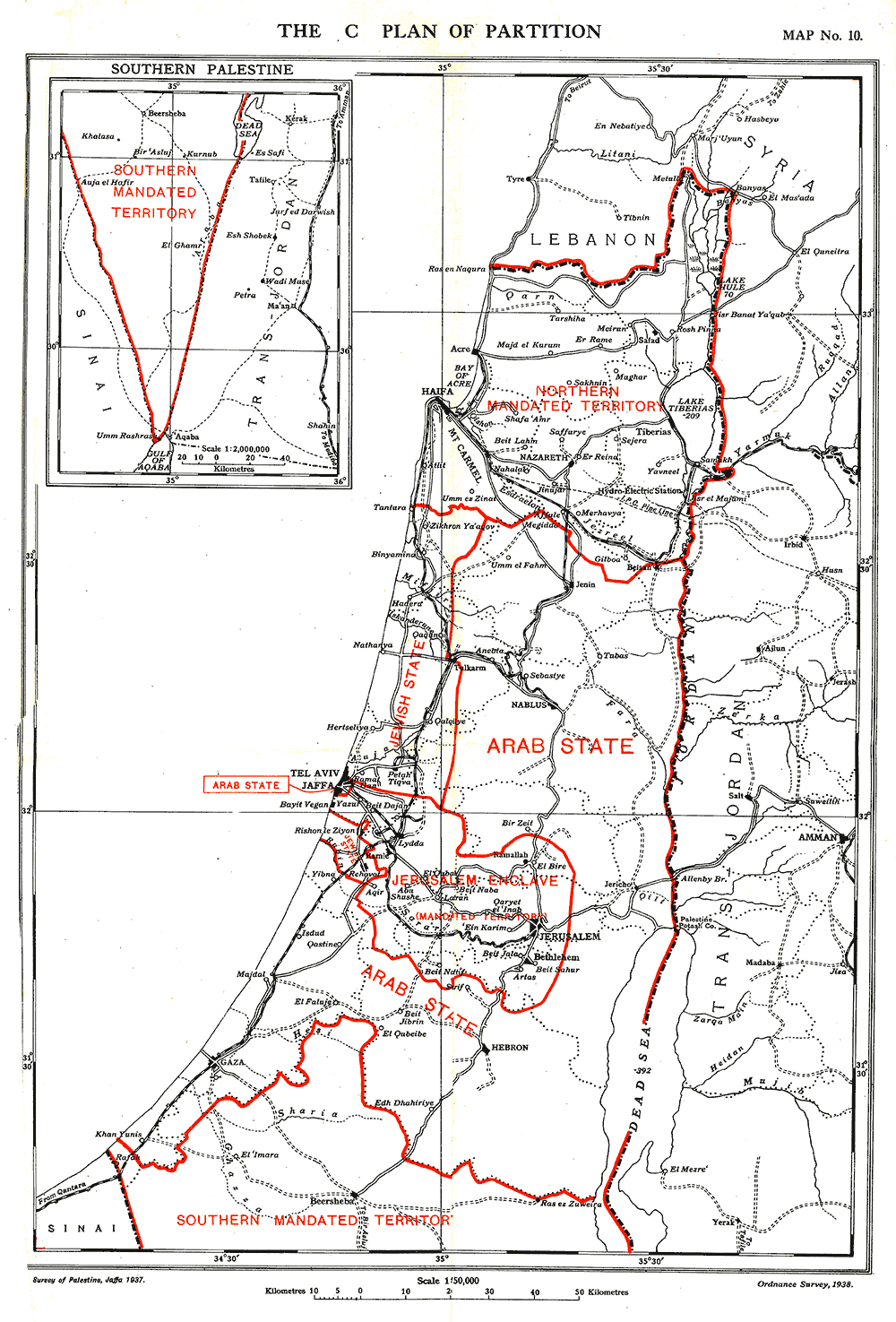
The Commission was appointed at the end of February 1938 and conducted its investigations from April to early August 1938. It rejected the Peel Commission's plan mainly on the grounds that it required a large transfer of Arabs, and considered two other plans. It preferred a modification of the partition, which forms a satisfactory basis of settlement, if the United Kingdom government accept "the very considerable financial liability involved,"[4] that balances the Arab state budget.[5] In this plan, the entire Galilee and a corridor from Jaffa to Jerusalem would remain under British mandate.
It published its conclusions on November 9, 1938, after which the British government rejected the imminent partition of Palestine as involving insurmountable "political, administrative and financial difficulties".[6] Britain called for a conference in London for all relevant parties to work out a compromise."

The Commission developed three plans with the following the recommended plan:


Key related points -

1) Motivation - Britain rejected the Peel Plan because it required a large transfer of Arabs and the Arabs refused to negotiate the Plan.

2) Expectation - Britain was now increasingly aware of the difficulties involved in creating any plan which was acceptable to both sides and thus had much lower expectations now regarding being able to create any currently successful plan.

3) Limitation - Since estimated tax revenue was significantly less among Arabs, if significantly less Arabs were transferred to a Jewish state, then Britain would have to provide significant financial assistance to the Arab state. Britain's related problem was that the smaller the Jewish State, the fewer Arabs would have to be transferred but the fewer the Arabs transferred, the greater Britain's related financial problem. In order to try and accomplish this, the proposed Jewish state would be one fifth the size as that under the Peel Commission, in order to minimize Arab transfer, and this Jewish state would have a significant tax imposed in order to help balance the budget of the Arab state.


4) Development - Disproportionate current and future development of Israel by Jews, which benefited/would benefit all inhabitants, was no longer a key consideration.

Jewish reaction -  

To the previous McMahon–Hussein Correspondence of 1916 promising the Arabs that most of Palestine would be an Arab state = None. 

To the Balfour Declaration of 1917 = Acceptance. Hope was turned into possibility and preparations were started for a Jewish State. The emphasis was on the creation of a Jewish State with little thought as to the extent of the Jewish State and whether there would also be a Palestinian state in Israel. 

To The Peel Commission of 1937 = Acceptance of the Plan in general but rejection of the specific borders as too small. Created committee to negotiate specific borders.

To the Woodhead Commission of 1938 = Rejection. Since the recommended Plan would give the Jews one fifth the area of the previous plan and they would be required to provide significant financial assistance to the Arab state which would be five times larger, the Plan was summarily rejected with no offer of negotiation. 


Arab reaction -

To the previous McMahon–Hussein Correspondence of 1916 promising the Arabs that most of Palestine would be an Arab state = Acceptance.

To the Balfour Declaration of 1917 = Rejection. The Arabs were clear that not only would they reject the creation of any Jewish state in Israel but they would be violently opposed. 

To The Peel Commission of 1937 = Rejection. The primary specific complaint was that it would give the Jews the best land. The Arabs rejected the granting of any land to the Jews under any form of administration and demanded an end to Jewish immigration. 

To the Woodhead Commission of 1938 = Ignored. The Woodhead Commission spent three months in Israel, had fifty-five evidence receiving meetings, and no Arabs participated. This even though the proposed Arab state would be five times larger than the Jewish state and receive significant financial assistance from the Jewish state. If instead of having simply a demand that there be no Jewish State the Arab position had been to just minimize the Jewish state and maximize the Arab one, historically, this would have been the best opportunity for the Arabs to do so.

3. Conclusion


Because the predecessor Plan, The Peel Commission, was accepted in principle by the Jews but not only rejected by the Arabs but created an Arab position of refusing to accept the creation of any Jewish state, Britain tried to create a new Partition Plan which would be much more favorable to the Arabs. The Peel Commission Plan was much more favorable to the Arabs as they would have an independent Palestinian state for Arabs, Jews would be required to contribute substantially to this Arab state and the Jewish state would be one fifth the size of the Palestinian state. As a result though, the Arab position did not change. They would not accept and would violently oppose the creation of any Jewish state.

Violent Arab rejection of The Balfour Declaration of 1917 was the start of the Israeli/Arab conflict which has continued to the present time and was the primary Arab reaction to The Woodhead Commission. We will also see in subsequent posts here that the position of the two sides regarding Jewish and Arab states in Israel has not changed since 1917:


Jewish position - Has always been in favor of and offered Two-State solution.

Arab position - Has always opposed and rejected offer of Two-State solution.  

In hindsight, the greatest tragedy regarding the failure of a Two-State solution was not that the Arabs still don't have a related State but that 6,000,000 Jews were murdered by a Country with the same main religion as Britain in a Continent with the same religion because there was no Jewish State at the time. 

Critics of Israel will try to demonize Israel by posturing and only looking at The Jews/Zionists/Israel's supposed eternal goal of wanting it all. But we need to distinguish between wanting and accepting. It's normal to want more than you are willing to accept but in negotiations what is most important is what you are willing to accept. And that is the difference between Israel and the Arabs and has always been the difference. Regardless of what both sides supposedly want, Israel has always been willing to accept a two-State solution and the Arabs have not.


Tuesday, May 31, 2016

The Strange Chapter Of Dr. Jewkyll And Mr. Hymn - Day 1


Continued from The Strange Chapter Of Dr. Jewkyll And Mr. Hymn

Day 1

Dear Diary, this morning I read Isaiah Chapter 53 as planned to see
if I would start to develop tendencies towards Christian beliefs as
Christians claim that it is the best evidence for the truth of
Christianity. But after I read it and then looked at the surrounding
chapters of Isaiah it was clear to me that the nation of Israel was
being described and not Jesus. I next looked at the rest of Isaiah
and couldn't find any support for the Christian interpretation that
Isaiah 53 describes the vicarious atonement of Jesus. Finally,
skimming through the rest of the Tanakh I can see that this type of
human sacrifice is expressly prohibited and condemned as a Pagan
ritual so I really don't understand how the Christians can view
Chapter 53 as they do. I've decided that tomorrow I will confine
myself to reading Chapter 53 alone so I've removed Isaiah from my
Tanakh and put the rest of the Tanakh in my safety deposit box. That
way I can focus on Chapter 53 just in case I missed something during
the first look through. No unusual behaviour noted. I had been
beating my computer chess program regularly at level 13 and was ready
to move up a level but tonight I could only manage a draw. Probably
just because I'm tired due to the experiment. I'll go to bed earlier
tonight.

Flipping channels, I accidently saw Donald Trump tonight, PT Von
Clownstick! What a buffoon. I removed Faux News from my list of
channels long ago and thought that was the only place you could still
see Clownstick. Anyway, I could only stand a few seconds of him.


Dr. Henry Jewkyll

Wednesday, May 25, 2016

The Israeli/Arab Conflict - The Peel Commission - 1937


1. Introduction of the Issue


Israel Before The British Mandate 
The question than, is if there has never been a country approximating Israel that was a Muslim/Arab country, and the original usage of the word for a geographical area "Palestine" by the British explicitly provided for a Jewish State, than why are Arabs in Israel now and since the British Mandate referred to as "Palestinians" as if they are the original citizens of a country called "Palestine"? 


The Israeli/Arab Conflict - The McMahon–Hussein Correspondence - 1916
"1. By allying with the British and helping to defeat the Ottomans, the Arabs did earn a national Arab State in the Middle East. 
2. The British promise/agreement to the Arabs for an Arab State preceded any such agreement with the Jews for a Jewish State in Israel.  
3. The British were clear that not all of the Middle East would be an Arab State and never formally communicated to the Arabs that Palestine would be part of an Arab State. 
4. While there never has been an Arab and or Muslim State approximating the area of Israel and under the Ottomans there was no "Palestine" entity or governing area approximating Israel, the British did use the name "Palestine" to refer to the area." 

The Israeli/Arab Conflict - The Balfour Declaration - 1917 
"Violent Arab rejection of The Balfour Declaration of 1917 was the start of the Israeli/Arab conflict which has continued to the present time. We will also see in subsequent posts here that the position of the two sides regarding Jewish and Arab states in Israel has not changed since 1917:

Jewish position - Has always been in favor of and offered Two-State solution.

Arab position - Has always opposed and rejected offer of Two-State solution."


2. Discussion


The Peel Commission - 1937 


"The Peel Commission, formally known as the Palestine Royal Commission, was a British Royal Commission of Inquiry, headed by Lord Peel, appointed in 1936 to investigate the causes of unrest in The League of Nations Mandate for Palestine administered by Britain following the six-month-long Arab general strike in Mandatory Palestine.
On July 7, 1937, the commission published a report that, for the first time, stated that the Mandate had become unworkable and recommended partition.[1] British cabinet endorsed the Partition plan in principle, but requested more information.[2]"

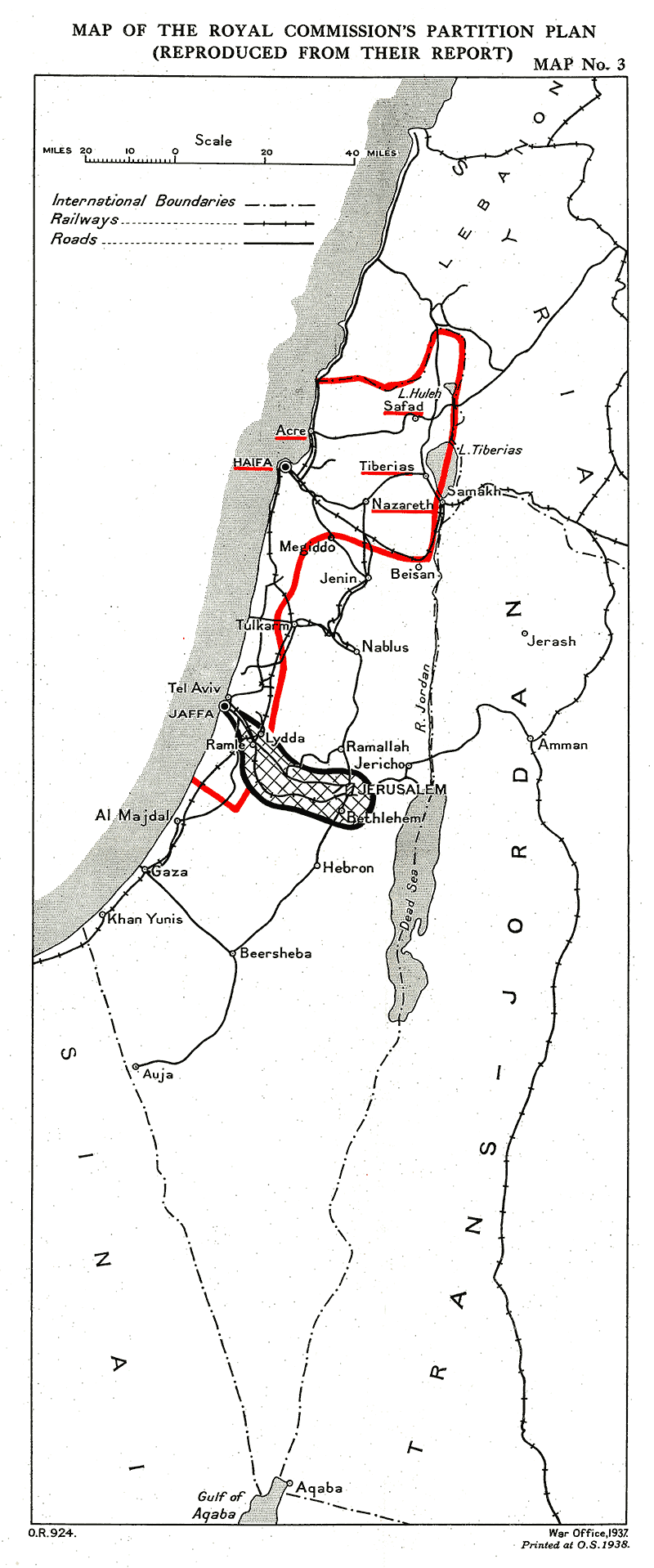
The Partition was per the following map with the Jewish side bordered in red:


"A Treaty system based on the Iraqi-Syrian precedent, proposed: Permanent mandates for the Jerusalem area and "corridor" stretching to the Mediterranean coast at Jaffa—and the land under its authority (and accordingly, the transfer of both Arab and Jewish populations) be apportioned between an Arab and Jewish state. The Jewish side was to receive a territorially smaller portion in the mid-west and north, from Mount Carmel to south of Be'er Tuvia, as well as the Jezreel Valley and the Galilee, while the Arab state linked with Trans-Jordan was to receive territory in the south and mid-east which included Judea, Samaria, and the sizable Negev desert.[18]"

Key related points -

1) Motivation - Britain decided that the current Mandate was not sustainable because Britain could not keep the peace. Primarily because of Arab violence and protest.


2) Expectation - Britain's expectation was unclear because The Peel Commission Plan was a defensive plan with Britain feeling forced to do what it did not want to do and was not ready to do.


3) Limitation - The Arab portion would not be an independent State but would become a part of Jordan. The Jewish State would have to pay a tax to help support the Arab side in order to relieve Britain of the burden. There would be a significant transfer of Arabs to the Arab portion and no specific plan to improve irrigation for the Arab side.


4) Development - The Jewish side was deliberately given a higher ratio of land in recognition that Jews provided more tax revenue per capita which would reduce/eliminate Britain's related financial support obligation. Britain recognized that Jewish immigration had significantly improved living conditions in Israel for everyone.

Jewish reaction -  

To the previous McMahon–Hussein Correspondence of 1916 promising the Arabs that most of Palestine would be an Arab state = None. 

To the Balfour Declaration of 1917 = Acceptance. Hope was turned into possibility and preparations were started for a Jewish State. The emphasis was on the creation of a Jewish State with little thought as to the extent of the Jewish State and whether there would also be a Palestinian state in Israel. 

To The Peel Commission of 1937 = Acceptance of the Plan in general but rejection of the specific borders as too small. Created committee to negotiate specific borders.


Arab reaction -

To the previous McMahon–Hussein Correspondence of 1916 promising the Arabs that most of Palestine would be an Arab state = Acceptance.

To the Balfour Declaration of 1917 = Rejection. The Arabs were clear that not only would they reject the creation of any Jewish state in Israel but they would be violently opposed. 

To The Peel Commission of 1937 = Rejection. The primary specific complaint was that it would give the Jews the best land. The Arabs rejected the granting of any land to the Jews under any form of administration and demanded an end to Jewish immigration. 

3. Conclusion


Even though the Peel Plan was the first specific partition plan it became the basis for all subsequent partition plans. The Plan favored the Jewish side because of British financial reasons and the thinking that the Jewish need for a State was much greater than the Arab need. From an Arab standpoint the Plan was unfavorable because they would receive the less developed land (even though the Jews were responsible for most of the development), they would receive proportionately less land based on relative populations (even though this would benefit both sides from a budget standpoint), most transfers would be of Arabs and they would not have an independent State but become a part of Jordan. 

Violent Arab rejection of The Balfour Declaration of 1917 was the start of the Israeli/Arab conflict which has continued to the present time and was the primary Arab reaction to The Peel Commission. We will also see in subsequent posts here that the position of the two sides regarding Jewish and Arab states in Israel has not changed since 1917:


Jewish position - Has always been in favor of and offered Two-State solution.

Arab position - Has always opposed and rejected offer of Two-State solution.  

In hindsight, the greatest tragedy regarding the failure of a Two-State solution was not that the Arabs still don't have a related State but that 6,000,000 Jews were murdered by a Country with the same main religion as Britain in a Continent with the same religion because there was no Jewish State at the time. 

Critics of Israel will try to demonize Israel by posturing and only looking at The Jews/Zionists/Israel's supposed eternal goal of wanting it all. But we need to distinguish between wanting and accepting. It's normal to want more than you are willing to accept but in negotiations what is most important is what you are willing to accept. And that is the difference between Israel and the Arabs and has always been the difference. Regardless of what both sides supposedly want, Israel has always been willing to accept a two-State solution and the Arabs have not.